On a whim, I chose to study Information and Communication Engineering, closest related keyword, Signal Processing, and Sister major, Electrical Engineering. I was paired with Cui GuoLong and his post-doc Xiang Xianyu. In order to learn more about radar filter design, I thought it would be a great idea to imitate one of his papers. He recommended, “Radar Waveform Design in a Spectrally Crowded Environment via Nonconvex Quadratic Optimization”. Prerequisites are engineering mathematics and good applied linear algebra chops, and convex optimization (into graduate level mathematics). In the original implemenation, Prof Cui uses MATLAB and the CVX library, and borrows code from some applied mathematics papers. I used the python interface to CVX, CVXpy, and the same MATLAB code. In the rest of this blog post, I’ll describe the waveform design problem and provide code and some diagnostic plots. Thanks to Prof Cui, his post-doc Xian, and the China Scholarship Council for the opportunity to take some advanced mathematics classes.
Full disclosure, there may be some gaps in this, I started writing this a year ago, and I implemented this 

Specifically, I’m missing how the authors transformed the quadratic program (QP) into an enlarged quadratic program (EQP), and some other modifications that transform 
Let 

Aubrey et al defines the energy spectral density as:


for

def compute_RI(N, f_1):
    R1 = np.zeros((N, N), dtype = complex)

    for m in range(0, N):
        for l in range(0, N):
            if (m != l):
                 R1[m, l] = (np.exp(np.pi * f_1[1] * ((m + 1) - (l + 1)) * 1j) - \
                    np.exp(np.pi * f_1[0] * ((m + 1) - (l + 1)) * 1j)) / \
                    (2 * np.pi * ((m + 1) - (l + 1)) * 1j)
    for n in range(0, N):
        R1[n, n] = f_1[1] - f_1[0]
    return R1
Next, I computed 


And 


The next, the authors makes some adjustments in order to make the problem solvable, by neglecting a constraint, which turn the problem into an enlarged quadratic problem relaxed (EQPR). The optimization problem becomes:

And then we can use CVXpy, the MATLAB convex optimization library in MATLAB that has a python interface. They transform the problem so that they can use disciplined convex programming, a way of implementing a convex optimization program, so that a language parser can parse the program and find the proper convex optimization algorithm to use. Here’s the CVXpy code, it’s really simple.
def P4(R, R_I, C0, EI = .264, eps = 1.3):  ## eps = .264
    delta_eps = (1 - eps / 2.0) ** 2
    N = R.shape[0]
    C = cp.Variable([N, N], PSD = True)  ## to mean c c'
    objective = cp.Minimize(cp.trace(C * np.real(R)) + cp.trace(C * np.imag(R)))
    constraints = [cp.trace(C) == 1,
                  (cp.trace(C * cp.real(R_I)) + cp.trace(C * cp.imag(R_I))) <= EI,
#                     (cp.trace(C * cp.real(R_I))) <= EI,
#                    (cp.trace(C * cp.real(C0)) + cp.trace(C * cp.imag(C0))) >= delta_eps,
                   C >> 0]
    problem = cp.Problem(objective, constraints)
    problem.solve()
    return [C, problem]
Next the authors do some performance analysis, which is like model validation but for radar engineering. I.E. does what I created actually work? Engineers usually always do this.
In order to simulate the, “spectrally crowded” environment, the authors construct an matrix, additive, that is composed of:
white interference:

where 

unlicensed narrow band continuous jammers:

where 


\textbf{licensed coexisting telecommunication networks, spectrally overlayed to the radar of interest}:

for 


![[f_2^k, f_1^k], for](https://s0.wp.com/latex.php?latex=%5Bf_2%5Ek%2C+f_1%5Ek%5D%2C+for+&bg=ffffff&fg=000&s=0&c=20201002)
and $R_{I,k}$ as defined above
total addive spectral model: in this order, additive interference, licensed telecommunication newtorks, and unlicesened jammers is then

The the other licensed telecommunication networks are spectrally overlayed, and can be accounted for in the model. The authors then consider baseband equivalent radar stop-bands denoted as 
We can then implement the additive model in python.
r_1_k = np.zeros(N, dtype = complex)
r_2_k = np.zeros(N, dtype = complex)
for i in range(0, N):
    r_1_k[i] = np.exp(2 * np.pi * .7 * (i + 1) * 1j)
    r_2_k[i] = np.exp(1j * 2 * np.pi * .75 * (i + 1))
R_J_1 = np.outer(r_1_k, np.asmatrix(r_1_k).H)
R_J_2 = np.outer(r_2_k, np.asmatrix(r_2_k).H)
R_J = [R_J_1, R_J_2]

omega_1 = [0.0000, 0.0617]
omega_2 = [0.0988, 0.2469]
omega_3 = [0.2593, 0.2840]
omega_4 = [0.3086, 0.3827]
omega_5 = [0.4074, 0.4938]
omega_6 = [0.5185, 0.5556]
omega_7 = [0.9383, 1.0000]
omega = [omega_1, omega_2, omega_3, omega_4,
         omega_5, omega_6, omega_7]

R_I_1 = compute_RI(N, [0.0000, 0.0617])
R_I_2 = compute_RI(N, [0.0988, 0.2469])
R_I_3 = compute_RI(N, [0.2593, 0.2840])
R_I_4 = compute_RI(N, [0.3086, 0.3827])
R_I_5 = compute_RI(N, [0.4074, 0.4938])
R_I_6 = compute_RI(N, [0.5185, 0.5556])
R_I_7 = compute_RI(N, [0.9383, 1.0000])
R_I = [R_I_1, R_I_2, R_I_3, R_I_4,
       R_I_5, R_I_6, R_I_7]

sigma_J = [50, 40]

M = np.zeros((N, N), dtype = complex)
R_I_k = np.zeros((N, N), dtype = complex)
for k in range(0, K):
    M += 10 / (omega[k][1] - omega[k][0]) * R_I[k]
    R_I_k += R_I[k]
R_I_k = np.matrix(R_I_k)

for k in range(0, K_j):
    M += sigma_J[k] * R_J[k]

M = np.asmatrix(M)
I = np.eye(N, N)
We can then apply algorithm one. In the paper, they do additional relaxations, but I’m just getting the essence of the paper.
Inputs: 


Output: Optimal solution 
- Solve SDP
and the optimal value v^*.
- if Rank(
- set
,
the eigen vector associated with the maximum eigenvalue of
- else if: Rank(
), then
- find
- else
- find
- end
- output


Proof from the Appendix, a Bit on Convex Optimization and Mathematical Theory
That’s the implementation, but note that most of the work that was done was in the appendix. I’ll walk through a few off the proofs, and provide some justification for each step. Most of the work, I suppose, for this paper was the theoretical work. I was first introduced to formal logic and proof writing in a class called transitions at Michigan State University by Dr. Hyejin Kim. We were taught direct proofs, proof by contradiction, induction, on mathematics we were already familiar with by prerequisite, so the focus was on understanding proof writing strategies. This was the first step we took at walking through direct proofs. It becomes overkill when you’re more comfortable with the branch of mathematics, you’re dealing with, but I’ll do it here as an exercise, both for myself and those interested. We took proofs, and each step, in a direct proof, we’d right out the theorem or the reason why this step was valid.
When solving a convex optimization problem, we have an objective or cost function, 

The first thing we’d like to is see if there exists at least one point intersection of the set of constraints, meaning that it is not null. Let’s write this out more rigorously. From Aubrey, et al, they’re placing constraints on the interference energy, 


In appendix A, for problem 


While writing this, I thought deeper about the authors’ claims. The author claims, for feasibility of 
Here’s a sketch of a proof, since this is a blog.
I set 

In proof by contradiction, we can disprove any statement by providing a single counterexample. i.e.:
Suppose we have a statement 
I’m going to wrap this one up. We’re getting long. We’ve learned how to tear a paper a part, imitate implementations, some telecom theory, some applied math and linear algebra, some signal processing, some linear algebra, and some formal logic.
As usual, any comments, feedback or critique is appreciated.
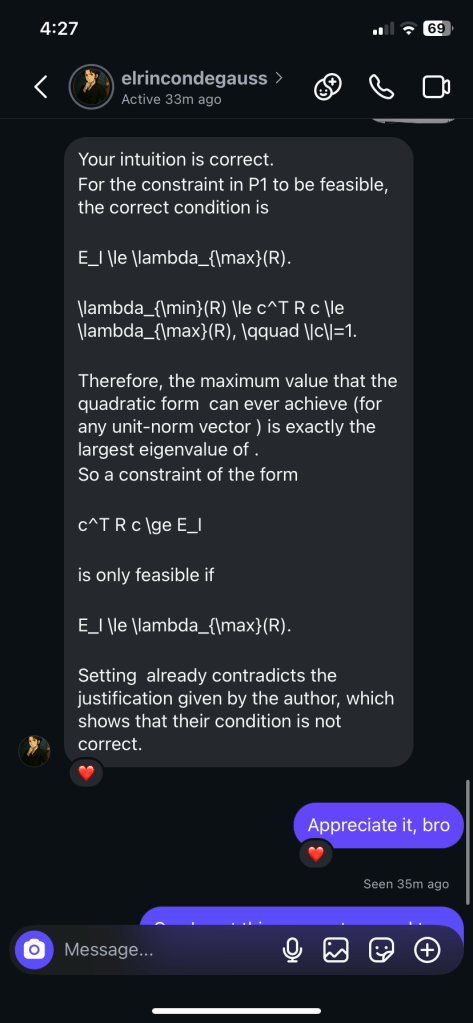
Thank you to the Chilean mathematician on instagram, who has the handle @elrincondegauss, who verified by intuition was true and provided a more rigorous explaination.
And per usual, here’s all the code I used. I skipped some parts of the paper to be brief in the description above. I captured the essence.
#!/usr/bin/env python
# coding: utf-8
# Radar Waveform Design in a Spectrally Crowded Environment
import cvxpy as cp
import numpy as np
from numpy import linalg as LA
import matplotlib.pyplot as plt
from oct2py import Oct2Py
from scipy import signal

oc = Oct2Py()
# In[2]:


def compute_RI(N, f_1):
    R1 = np.zeros((N, N), dtype = complex)

    for m in range(0, N):
        for l in range(0, N):
            if (m != l):
                 R1[m, l] = (np.exp(np.pi * f_1[1] * ((m + 1) - (l + 1)) * 1j) - \
                    np.exp(np.pi * f_1[0] * ((m + 1) - (l + 1)) * 1j)) / \
                    (2 * np.pi * ((m + 1) - (l + 1)) * 1j)
    for n in range(0, N):
        R1[n, n] = f_1[1] - f_1[0]
    return R1


# In[5]:


def compute_C0(N):
    K_s = (750 * 10^3) / (200 * 10^-6)
    f_s = 200.0
    c0 = np.array([], dtype = complex);
    for n in range(0, N):
        c0 = np.append(c0, 1 / np.sqrt(N) * np.exp(2j * np.pi * K_s * pow(n / f_s, 2)))
    c0 = np.asmatrix(c0)
    C0 = np.outer(c0, c0.H)
    return [np.asmatrix(C0), c0]


# In[6]:


def P4(R, R_I, C0, EI = .264, eps = 1.3):  ## eps = .264
    delta_eps = (1 - eps / 2.0) ** 2
    N = R.shape[0]
    C = cp.Variable([N, N], PSD = True)  ## to mean c c'
    objective = cp.Minimize(cp.trace(C * np.real(R)) + cp.trace(C * np.imag(R)))
    constraints = [cp.trace(C) == 1,
                  (cp.trace(C * cp.real(R_I)) + cp.trace(C * cp.imag(R_I))) <= EI,
#                     (cp.trace(C * cp.real(R_I))) <= EI,
#                    (cp.trace(C * cp.real(C0)) + cp.trace(C * cp.imag(C0))) >= delta_eps,
                   C >> 0]
    problem = cp.Problem(objective, constraints)
    problem.solve()
    return [C, problem]


# In[7]:


def mag2db(x):
    return 20 * np.log(np.sqrt(np.real(x) ** 2 + np.imag(x) ** 2))


# In[8]:


## performance analysis

N = 50
sigma_0 = 0 ## thermal noise level
K = 7 ## number of licensed radiators
sigma_ik = 10 ## energy of the kth coexisting telecommunication network
K_j = 2  ## number fo active jammers
sigma_jk = np.array([50, 40])
f_1 = np.array([0.0, .15])
f_2 = np.array([0.98, 0.99])
delta_f_1 = f_1[1] - f_1[0]
delta_f_2 = f_2[1] - f_2[0]

### use R_I_k as above
r_1_k = np.zeros(N, dtype = complex)
r_2_k = np.zeros(N, dtype = complex)
for i in range(0, N):
    r_1_k[i] = np.exp(2 * np.pi * .7 * (i + 1) * 1j)
    r_2_k[i] = np.exp(1j * 2 * np.pi * .75 * (i + 1))
R_J_1 = np.outer(r_1_k, np.asmatrix(r_1_k).H)
R_J_2 = np.outer(r_2_k, np.asmatrix(r_2_k).H)
R_J = [R_J_1, R_J_2]

omega_1 = [0.0000, 0.0617]
omega_2 = [0.0988, 0.2469]
omega_3 = [0.2593, 0.2840]
omega_4 = [0.3086, 0.3827]
omega_5 = [0.4074, 0.4938]
omega_6 = [0.5185, 0.5556]
omega_7 = [0.9383, 1.0000]
omega = [omega_1, omega_2, omega_3, omega_4,
         omega_5, omega_6, omega_7]

R_I_1 = compute_RI(N, [0.0000, 0.0617])
R_I_2 = compute_RI(N, [0.0988, 0.2469])
R_I_3 = compute_RI(N, [0.2593, 0.2840])
R_I_4 = compute_RI(N, [0.3086, 0.3827])
R_I_5 = compute_RI(N, [0.4074, 0.4938])
R_I_6 = compute_RI(N, [0.5185, 0.5556])
R_I_7 = compute_RI(N, [0.9383, 1.0000])
R_I = [R_I_1, R_I_2, R_I_3, R_I_4,
       R_I_5, R_I_6, R_I_7]

sigma_J = [50, 40]

M = np.zeros((N, N), dtype = complex)
R_I_k = np.zeros((N, N), dtype = complex)
for k in range(0, K):
    M += 10 / (omega[k][1] - omega[k][0]) * R_I[k]
    R_I_k += R_I[k]
R_I_k = np.matrix(R_I_k)

for k in range(0, K_j):
    M += sigma_J[k] * R_J[k]

M = np.asmatrix(M)
I = np.eye(N, N)


# In[9]:


## algorithm 1
## 1
M = R_I_k
[C0,c0] = compute_C0(N)
P4_out = P4(M, R_I_k, C0)
C_bar = np.asmatrix(P4_out[0].value)
C_bar = C_bar + 1e-3 * np.eye(N,N)  ## force to PSD
v_star = P4_out[1].value
rank_C_bar = np.rank(C_bar)
if rank_C_bar == 1:
    c_bar = np.sqrt(max(LA.eigvalsh(C_bar)))
    max_eig_index = np.where(LA.eigvalsh(C_bar) == max(LA.eigvalsh(C_bar)))
    w, v_arr = LA.eig(C_bar)
    v = v_arr[:,9];
elif rank_C_bar == 2:
    c_bar = oc.fcndcmps14(M, I, R_I_k, C0, C_bar)
else:
    c_bar = oc.fcndcmps14(M, I, R_I_k, C0, C_bar)
c_star = c_bar * np.exp(1j * np.angle(np.dot(np.asmatrix(c_bar).H.shape, c0.H.shape)))


# ## Make plots

# In[10]:


plt.acorr(np.abs(c_star[:,0]) ** 2, maxlags = None,
          usevlines = False, linestyle = '-', marker = '')
plt.show()


# In[11]:


fs = 10e3
N = 1e5
amp = 2*np.sqrt(2)
freq = 1234.0
noise_power = 0.001 * fs / 2
time = np.arange(N) / fs
x = amp*np.sin(2*np.pi*freq*time)
x += np.random.normal(scale=np.sqrt(noise_power), size=time.shape)

f, Pxx_den = signal.welch(x, fs, nperseg=1024)
plt.semilogy(f, Pxx_den)
plt.ylim([0.5e-3, 1])
plt.xlabel('frequency [Hz]')
plt.ylabel('PSD [V**2/Hz]')
plt.show()


# In[1]:


get_ipython().system('jupyter nbconvert --to script mycode.ipynb')
with open('spectrally_crowded.py', 'r') as f:
    lines = f.readlines()
with open('spectrally_crowded.py', 'w') as f:
    for line in lines:
        if 'nbconvert --to script' in line:
            break
        else:
            f.write(line)
%% Matlab Code for rank-one decomposition - by Yongwei Huang and Shuzhong Zhang
%% April 2007
%% Plus the additional functions: solneqnsys.m
%% solneqn3.m
%% solneqnsys3.m
%% fcndcmps12.m
%% input: A (real symmetric, Hermitian)
%% B (real symmetric, Hermitian)
%% C (real symmetric, Hermitian)
%% X (psd, complex Hermitian symmetric, and could be real symmetric)
%% output: Xs: each column of Xs is the decomposed vector;
%% r: rank of X;
%% rdel= trace(AX)/r
%% rdelb=trace(BX)/r
%% redlc=trace(CX)/r
%% clas1=Xs(:,r-1)'*C*Xs(:,r-1)
%% clas2=Xs(:,r)'*C*Xs(:,r)
%% Given problem size: n
%% Methods to randomly generate A:
%% construct A (Hermitian):
%% method 1:
%A1=randn(n);
%A2=randn(n);
%A=(A1+i*A2+(A1+i*A2)')/2;
%% method 2:
%A1=randn(n);
%UA1=triu(A1); %get A1's upper triangle matrix including diagonal elements
%LA1=tril(A1);
%A=UA1+UA1'-diag(diag(UA1))+i*(LA1-LA1');
%% construct A (real symmetric)
%A=real(A);
%or
%A=(A1+A1')/2;
%% construct integer-entry A
% A=round(10*A) % or A=fix(10*A);
%% construct B
%% method 1:
%B1=randn(n);
%B2=randn(n);
%B=(B1+i*B2+(B1+i*B2)')/2;
%% method 2:
%B1=randn(n);
%UB1=triu(B1); % get B1's upper triangle matrix including diagonal elements
%LB1=tril(B1);
%B=UB1+UB1'-diag(diag(UB1))+i*(LB1-LB1');
%% construct B (real symmetric)
%B=real(B);
%or
%B=(B1+B1')/2;
%% construct integer-entry B
% B=round(10*B) % or B=fix(10*B);
%% construct C
%% method 1:
%C1=randn(n);
%C2=randn(n);
%C=(C1+i*C2+(C1+i*C2)')/2;
%% method 2:
%C1=randn(n);
%UC1=triu(C1); % get C1's upper triangle matrix including diagonal elements
%LC1=tril(C1);
%C=UC1+UC1'-diag(diag(UC1))+i*(LC1-LC1');
%% construct C (real symmetric)
%C=real(C);
%or
%C=(C1+C1')/2;
%% construct integer-entry C
% C=round(10*C) % or C=fix(10*C);
%% construct X: method 1
%X1=randn(n);X2=randn(n);
%X=(X1+i*X2)*(X1+i*X2)';
% construct X (psd, real symmetric)
%X=real(X);
%% construct X: method 2
%rr=n-1; % rank of X, this parameter is only for the use of generating X, controlling the rank of X.
%X=zeros(n);
%for ii=1:rr
% rdv=randn(n,1);
% idv=randn(n,1);
% X=X+(rdv+i*idv)*(rdv+i*idv)';
%end
%% construct integer-entry X:
%rr=n-1;
%X=zeros(n);
%for ii=1:rr
% rdv=floor(randn(n,1)); % ceil, round, fix
% idv=floor(randn(n,1));
% X=X+(rdv+i*idv)*(rdv+i*idv)';
%end
% construct X (psd, real, rank controlled)
%rr=n-1;
%X=zeros(n);
%for ii=1:rr
% rdv=randn(n,1);
% X=X+(rdv)*(rdv)';
%end
%% function starts...
function [Xs,r,rdel,rdelb,rdelc,clas1,clas2]=fcndcmps13(A,B,C,X)
epsi=10^(-8);
%% begin of checking inputs
% check size of inputs
%if isreal(X)
% disp('X should be complex-valued matrix.');
% return;
%end
%% when inputs A,B,C,X are real, it can works as well (outputting rank-2
%% decomposition of X);
[rowA,colA]=size(A);
[rowB,colB]=size(B);
[rowC,colC]=size(C);
[rowX,colX]=size(X);
if (rowA==colA)&&(rowB==colB)&&(rowC==colC)&&(rowX==colX)&&(rowX==rowA)&&(rowA==rowB)&&(rowB==rowC)
n=rowA;
else
error('A, B, C and X must be square matrices and the same size.');
%disp('A, B, C and X must be square matrices and the same size.');
%return;
end
%n=length(diag(X));
if n<=2
error('Size must be >=3.');
%disp('Size must be >=3.');
%return;
end
% check Hermitian or symmetric of A, B, C and X
for ii=1:n-1
for jj=ii+1:n
if (abs(real(A(ii,jj)-A(jj,ii)'))>10^(-10)) || (abs(imag(A(ii,jj)-A(jj,ii)'))>10^(-10)) ||(abs(real(B(ii,jj)-B(jj,ii)'))>10^(-10)) || (abs(imag(B(ii,jj)-B(jj,ii)'))>10^(-10)) || (abs(real(C(ii,jj)-C(jj,ii)'))>10^(-10)) || (abs(imag(C(ii,jj)-C(jj,ii)'))>10^(-10)) || (abs(real(X(ii,jj)-X(jj,ii)'))>10^(-10)) || (abs(imag(X(ii,jj)-X(jj,ii)'))>10^(-10))
error('A, B, C and X must be Hermitian.');
%disp('A, B, C and X must be Hermitian.');
%return;
end
end
end
% check positive semidefinitness of X
eigX=eig(X);
for ii=1:n
if eigX(ii)<=-10^(-10)
error('X must be positive semidefinite.');
%disp('X must be positive semidefinite.');
%return;
end
end
% rank of X
%r=rank(X);
r=0;
for ii=1:n
if abs(eigX(ii))>=10^(-10)
r=r+1;
end
end
if r<=2
error('The rank of X should be >= 3');
%disp('The rank of X should be >= 3');
%return;
end
%% end of checking input
%define Xs to save decomposed vectors
Xs=zeros(n);
%inner products
%vA=vect(A);
%vB=vect(B);
%vC=vect(C);
%vX=vect(X);
%delta=real((vA)'*vX);
%% delta=trace(A'*X)=trace(X'*A)=trace(A*X')=trace(A*X)
delta=real(trace(A*X'));
rdel=delta/r;
%delta=real((vB)'*vX);
delta=real(trace(B*X'));
rdelb=delta/r;
%delta=real((vC)'*vX);
delta=real(trace(C*X'));
rdelc=delta/r;
clas1=0;
clas2=0;
%% if X is Hermitian, then please use function fcndcmps12.m
%if norm(imag(vect(X)))>=epsi % or norm(imag(X),'fro')>=epsi, if no vect.m
% Xs=fcndcmps12(A,B,X);
% return
%end
%% if B=0, please use function fcndcmps1.m
%if norm(vect(B))<=epsi % or norm(B,'fro')<=epsi, if no vect.m
% Xs=fcndcmps1(A,X);
% return
%end
%% if rank of X <=2, done return solution infomation
%if (r<=2)
% Xs=fcndcmps12(A,B,X);
% disp('rank of X <=2, only return solution satisfying A,B, but not for C')
% return
%end
rt=r; % rank test, rt from r to 2; rt>=3
Xs1=zeros(n);
Xu=X;
for ii=1:n
Xs1=fcndcmps12(A,B,Xu); %% rank(Xs1)=rank(Xu)=r-rank(Xs)
%% find v1 and v2 s.t. v1'*C*v1>rdelc, v2'*C*v2<rdelc, and
%% v1'*A*v1=v2'*A*v2=rdel,v1'*B*v1=v2'*B*v2=rdelb
v1=zeros(n,1);
v2=zeros(n,1);
for jj=1:n
vv=Xs1(:,jj);
if norm(vv)>=epsi
deltemp=real(vv'*C*vv); %or real(vC'*vect(vv*vv')) or real(trace(C*(vv*vv')))
if (deltemp>rdelc)&&(abs(deltemp-rdelc)>=epsi)&&(norm(v1)==0)
v1=vv;
dltp1=deltemp-rdelc;
jj1=jj;
elseif (deltemp<rdelc)&&(abs(deltemp-rdelc)>=epsi)&&(norm(v2)==0)
v2=vv;
dltp2=deltemp-rdelc;
jj2=jj;
end
else
continue
end
if (norm(v1)>0)&&(norm(v2)>0)
break;
end
end
if (norm(v1)==0)&&(norm(v2)==0) %%could be norm(v1)==0 || norm(v2)==0
break; %% break 1, rarely happen; after the break, rt>=3, norm(v1)==0, norm(v2)==0, i.e., Xs already equalized with A,B,C.
end
%%end find v1 and v2
%% find v3 from Xs1 s.t. v3~=0, v3~v1, v3~=v2; rank(Xs1)=rt >=3 at the
%% moment
v3=zeros(n,1);
for jj=1:n
if (jj~=jj1)&&(jj~=jj2)&&(norm(Xs1(:,jj))>epsi)
v3=Xs1(:,jj);
break;
end
end
%% v3 found; if v3=0, the only case is rank(Xs1)=2, which will not
%% happen here.
%% find a new x
a=zeros(12,1);
a(1)=v1'*A*v2;a(2)=v2'*A*v3;a(3)=v3'*A*v1;
a(4)=v1'*B*v2;a(5)=v2'*B*v3;a(6)=v3'*B*v1;
a(7)=dltp1;a(8)=dltp2;a(9)=2*v1'*C*v2;a(10)=2*v2'*C*v3;a(11)=2*v3'*C*v1;a(12)=real(v3'*C*v3-rdelc);
s=solneqnsys3(a);
newx=(s(1)*v1+s(2)*v2+s(3)*v3)/(norm(s)); %% s must be a non-zero soln.
Xs(:,(r-rt+1))=newx;
Xu=Xu-newx*newx';
rt=rt-1;
if rt==2
break; %% break 2, must happen; after the break, rt==2, but norm(v1)>0, and norm(v2)>0.
end
end
%continue break 1: rt>=3, rarely happen
if rt>=3
disp('f13 Done-1'); %% no v1, v2 found, this case happens only when Xs1=0, or Xs1 equalized with C
% at the moment the rank of Xs1 is rt>=3; rank(Xs1)=rank(Xu)=rt,
% rank(Xs)=r-rt
DeXs1=zeros(n,rt);
jj=1;
for ii=1:n
if norm(Xs1(:,ii))>epsi
DeXs1(:,jj)=Xs1(:,ii); % rank of Xs1 = rt
jj=jj+1;
end
end
Xs(:,(r-rt+1):r)=DeXs1;
end
%continue break 2: rt==2, must happen
if rt==2
DeXs1=zeros(n,rt);
Xs1=fcndcmps12(A,B,Xu);
jj=1;
for ii=1:n
if norm(Xs1(:,ii))>epsi
DeXs1(:,jj)=Xs1(:,ii); % rank of Xs1 = rt
jj=jj+1;
end
end
Xs(:,(r-rt+1):r)=DeXs1;
end
r;
rdel;
Xs(:,r-2)'*A*Xs(:,r-2);
Xs(:,r-1)'*A*Xs(:,r-1);
Xs(:,r)'*A*Xs(:,r);
rdelb;
Xs(:,r-2)'*B*Xs(:,r-2);
Xs(:,r-1)'*B*Xs(:,r-1);
Xs(:,r)'*B*Xs(:,r);
rdelc;
Xs(:,r-2)'*C*Xs(:,r-2);
clas1=real(Xs(:,r-1)'*C*Xs(:,r-1));
clas2=real(Xs(:,r)'*C*Xs(:,r));%% This function is to solve the following equation:
%% imag(conj(s(1))*s(2))+real(a(1)*conj(s(2)))+real(a(2)*s(1))+a(3)=0.
%% Inputs(coefficients of the equation): a(1),a(2): complex or real number;
%% a(3): real;
%% Output(solution): s(1),s(2).
function s=soln_1eqn_3n(a)
epsi=10^(-8);
a2=a(1);a3=a(2);a4=real(a(3));
s=zeros(2,1);
s1=s(1);s2=s(2);
%% check in input
if (length(a)~=3)||(abs(imag(a(3)))>=epsi)
disp('coefficents assumption not satisfied - Stop 1 from soln_1eqn_3n')
return
end
%% end of check in input
u2=abs(a2);xsi2=angle(a2);
u3=abs(a3);xsi3=angle(a3);
if abs(a4)<epsi % or abs(a4)==0
s1=0;s2=0;
else
if (u2<epsi)&&(u3<epsi) % or (u2==0)&&(u3==0)
s1=1;s2=-a4*i;
end
if (u2>=epsi) % or u2~=0
s1=0;s2=-a4/u2*exp(i*xsi2);
end
if (u3>=epsi)&&(u2<epsi) % or u3~=0 && u2==0
s1=-a4/u3*exp(i*(-xsi3));s2=0;
end
end
s(1)=s1;s(2)=s2;
% test:
% ia=randn(3,1);ib=randn(3,1);a=complex(ia,ib);a(3)=real(a(3));
% s=soln_singleeqn_3n(a);
%eqn=imag(conj(s(1))*s(2))+real(a(1)*conj(s(2)))+real(a(2)*s(1))+a(3) %% is it equal to zero? %% this function is to solve the following two equations with 3 vars.
%% a1*s1*s2+a2*s2*s3+a3*s1*s3 =0
%% bm1*s1^2+b0*s2^2+b1*s1*s2+b2*s2*s3+b3*s1*s3+b4*s3^2=0,
%% where bm1>0 and b0<0;
%% input: a -- 9-dim vector (real number)
%% output: s1,s2,s3: a solution of the equation system
%% (as long as bm1*b0<0, there must be a NONZERO solution)
function s=solneqnsys(a)
epsi=10^(-8);
a1=a(1);a2=a(2);a3=a(3);
bm1=a(4);b0=a(5);b1=a(6);b2=a(7);b3=a(8);b4=a(9);
s=zeros(3,1);
s1=s(1);s2=s(2);s3=s(3);
if (length(a)~=9)||(bm1*b0>=0)
disp('coefficents assumption not satisfied - from solneqnsys')
return
end
if bm1<0
bm1=-bm1;b0=-b0;b1=-b1;b2=-b2;b3=-b3;b4=-b4;
end
if abs(a1)<=epsi
s3=0;s2=1;s1=(-b1+sqrt(b1^2-4*bm1*b0))/(2*bm1);
return
else
s3=1;
end
if (abs(a2)<=epsi)&&(abs(a3)<=epsi)
if b4<=0
s2=0;s1=(-b3+sqrt(b3^2-4*bm1*b4))/(2*bm1);
else
s1=0;s2=(-b2+sqrt(b2^2-4*b0*b4))/(2*b0);
end
elseif (abs(a2)>epsi)&&(abs(a3)<=epsi)
if b4<=(b3^2)/(4*bm1)
s2=0;s1=(-b3+sqrt(b3^2-4*bm1*b4))/(2*bm1);
else
s1=-a2/a1;
c1=b2+b1*s1;
c2=bm1*(s1)^2+b3*s1+b4;
s2=(-c1+sqrt(c1^2-4*b0*c2))/(2*b0);
end
elseif (abs(a2)<=epsi)&&(abs(a3)>epsi)
if b4>=(b2^2)/(4*b0)
s1=0;s2=(-b2+sqrt(b2^2-4*b0*b4))/(2*b0);
else
s2=-a3/a1;
c1=b3+b1*s2;
c2=b0*(s2)^2+b2*s2+b4;
s1=(-c1+sqrt(c1^2-4*bm1*c2))/(2*bm1);
end
elseif (abs(a2)>epsi)&&(abs(a3)>epsi)
lam1=(a1^2)*b0;
lam2=2*a1*a3*b0-a1*a2*b1+(a1^2)*b2;
lam3=(a2^2)*bm1+(a3^2)*b0-a2*a3*b1+2*a1*a3*b2-a1*a2*b3+(a1^2)*b4;
lam4=(a3^2)*b2-a2*a3*b3+2*a1*a3*b4;
lam5=b4*a3^2;
rs=roots([lam1,lam2,lam3,lam4,lam5]);
for ii=1:length(rs)
if (abs(imag(rs(ii)))<=epsi)&&(abs(a3+a1*real(rs(ii)))>epsi)
s2=real(rs(ii));
s1=-a2*s2/(a3+a1*s2);
break;
end
end
end
s(1)=s1;s(2)=s2;s(3)=s3;
% Test:
% a=randn(9,1);a(4)=abs(a(4));a(5)=-abs(a(5));
% s=solneqnsys(a);
%eqn1=a(1)*s1*s2+a(2)*s2*s3+a(3)*s1*s3
%eqn2=a(4)*s1^2+a(5)*s2^2+a(6)*s1*s2+a(7)*s2*s3+a(8)*s1*s3+a(9)*s3^2And then here’s Elrin’s explanation (I think that’s his name? I really don’t know). Instagram has disabled my account and I’ve lost contact. But this took him like, 4 minutes. I was impressed. It took me 10.

 likely llc
Leave a comment