Prior to starting at SAS, I was still consulting and working for Michigan. I wanted to make a logo for Likely LLC, to make it appear more credible. Models are meaningless without good advertising and visualizations, to non-statisticians. I was attempting to make an L with mathematics and machine learning/statistics. So I simulated a Paul Wavelet, added some additive white Gaussian noise (AWGN), and then fit a Gaussian process regression model and plotted a few realizations. It didn’t quite look like an L, but I had to prepare for an interview. Admittedly, probably, the most useless application of these tools is to make art. Below is some of the code. I had to use a few different programming languages. Python, Stan, R. Python I can’t find. You can see me experimenting with different colors, but you can also play around with the amount of realizations and stuff.
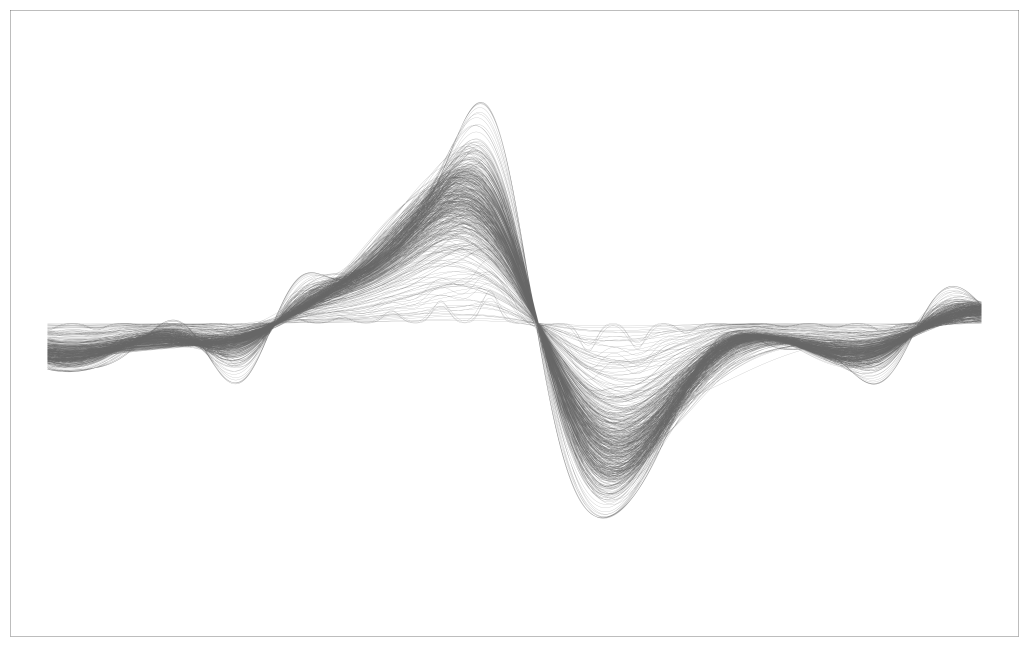
setwd("/home/andre/likely/logo/")library(rstan);set.seed(1);x = read.csv("paul2_wavelet.csv");x = as.matrix(x);x = x[seq(1,length(x), by = 30)]; ## evenly spacedN = length(x);## sample by index# N2 = 20;# x_sub = sort(sample(1:N, size = N2));# plot(1:N, x);# plot(1:N2, x[x_sub]);x_eps = x + rnorm(N, 0, .1)plot(1:N, x_eps)N = N;D = 1;y = as.vector(x_eps);x = as.matrix(1:length(y));N_pred = 1000;x_pred = as.matrix(seq(min(x) - 10, max(x) + 10, length.out = 1000));rstan::stan_rdump(list = c("N", "D", "x", "y", "N_pred", "x_pred"), file = "paul_sim.staninput");####csv = read_stan_csv("output.csv");samples = rstan::extract(csv);for (i in 101:200){ plot(samples$f_pred[i, 0:1000],ylim = c(-1,1), type = "l", yaxt = "n", xaxt = "n", xlab = "", ylab = "", col = "grey") par(new = T)}for (i in 1:300){ plot(samples$f_pred[i, 0:1000],ylim = c(-1,1), type = "l", yaxt = "n", xaxt = "n", xlab = "", ylab = "", col = "grey") par(new = T)}for (i in 1:500){ plot(samples$f_pred[i, 0:1000],ylim = c(-1,1), type = "l", yaxt = "n", xaxt = "n", xlab = "", ylab = "", col = "grey") par(new = T)}for (i in 1:500){ plot(samples$f_pred[i, 0:1000],ylim = c(-1,1), type = "l", yaxt = "n", xaxt = "n", xlab = "", ylab = "", col = "gray40") par(new = T)}for (i in 1:500){ plot(samples$f_pred[i, 0:1000],ylim = c(-1,1), type = "l", yaxt = "n", xaxt = "n", xlab = "", ylab = "", col = "gray50") par(new = T)}
functions { vector gp_pred_rng(vector[] x_pred, vector y1, vector[] x, real magnitude, real length_scale, real sigma) { int N = rows(y1); int N_pred = size(x_pred); vector[N_pred] f2; { matrix[N, N] K = add_diag(gp_exp_quad_cov(x, magnitude, length_scale), sigma); matrix[N, N] L_K = cholesky_decompose(K); vector[N] L_K_div_y1 = mdivide_left_tri_low(L_K, y1); vector[N] K_div_y1 = mdivide_right_tri_low(L_K_div_y1', L_K)'; matrix[N, N_pred] k_x_x_pred = gp_exp_quad_cov(x, x_pred, magnitude, length_scale); f2 = (k_x_x_pred' * K_div_y1); } return f2; }}data { int<lower=1> N; int<lower=1> D; vector[D] x[N]; vector[N] y; int<lower=1> N_pred; vector[D] x_pred[N_pred]; //real x_pred[N_pred];}transformed data { vector[N] mu; mu = rep_vector(0, N);}parameters { real<lower=0> magnitude; real<lower=0> length_scale; real<lower=0> sig; real<lower=0> sigma;}transformed parameters { matrix[N, N] L_K; { matrix[N, N] K = gp_exp_quad_cov(x, magnitude, length_scale); K = add_diag(K, square(sigma)); L_K = cholesky_decompose(K); }}model { magnitude ~ normal(0, 1); length_scale ~ normal(0, 1); sig ~ normal(0, 1); sigma ~ normal(0, 1); y ~ multi_normal_cholesky(mu, L_K);}generated quantities { vector[N_pred] f_pred = gp_pred_rng(x_pred, y, x, magnitude, length_scale, sigma); vector[N_pred] y_pred; for (n in 1:N_pred) y_pred[n] = normal_rng(f_pred[n], sigma);}


Leave a comment